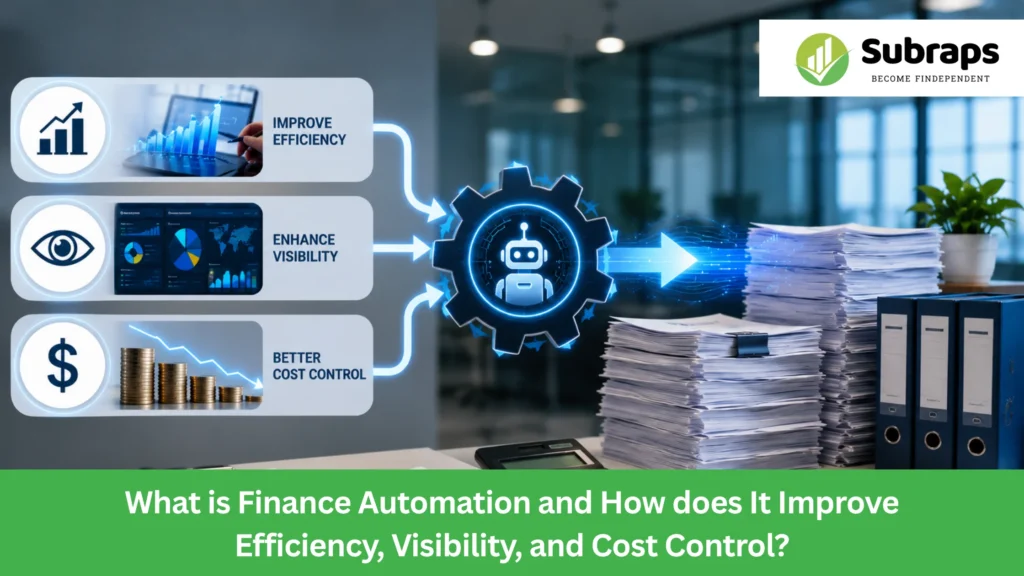
Finance leaders today are expected to do more than manage numbers. They play a critical role in improving operational efficiency, controlling costs, managing risk, and providing financial insights that support business growth and strategic decision-making.
However, many organisations still rely on manual finance processes that struggle to keep pace with growing transaction volumes. Tasks such as invoice processing, approvals, reconciliations, and reporting consume valuable time, increase costs, and limit visibility into financial performance. As a result, finance automation solutions is becoming a strategic priority, helping businesses streamline operations, improve accuracy, strengthen controls, and enable finance teams to focus on higher-value activities.
What is Finance Automation?
Finance automation is the use of technology, workflow automation, and intelligent systems to streamline repetitive financial processes and reduce manual effort. Instead of relying on spreadsheets, emails, and disconnected systems, businesses can automate key finance activities to improve efficiency, consistency, and visibility.
Finance process automation supports a wide range of processes, including accounts payable, accounts receivable, financial reporting, reconciliations, compliance monitoring, and workflow management. The goal is not to replace finance professionals but to eliminate repetitive tasks so they can focus on analysis, planning, forecasting, and strategic decision-making.
Why Manual Finance Processes are Holding Businesses Back?
Many organizations continue to rely on manual finance processes that were built for a smaller scale of operations. As businesses grow, these processes become increasingly difficult to manage and often create operational bottlenecks.
Time-Consuming Manual Tasks
Finance teams spend hours processing invoices, managing approvals, reconciling accounts, and preparing reports. These activities are necessary but consume valuable resources that could be directed toward more strategic work.
Limited Financial Visibility
When financial information is spread across multiple spreadsheets and systems, gaining a clear view of business performance becomes difficult. Delayed access to data often leads to delayed decisions.
Rising Operational Costs
As transaction volumes increase, businesses often add resources to manage the workload. This approach may solve short-term challenges but can significantly increase operating costs over time.
Increased Risk of Errors
Manual processes increase the likelihood of data entry mistakes, duplicate records, missed approvals, and reporting inaccuracies that can affect business performance and compliance.
Slower Decision-Making
Without timely and accurate financial information, leadership teams may struggle to respond quickly to market changes, operational challenges, and growth opportunities.
Why are Businesses Prioritizing Finance Automation?
Businesses are under constant pressure to improve efficiency, control costs, and gain better visibility into financial performance. As transaction volumes increase and financial processes become more complex, finance automation helps organizations streamline operations, improve productivity, and support sustainable business growth.
Key reasons businesses are prioritizing finance automation include the following:
- Increasing Transaction Volumes
- Demand for Real-Time Visibility
- Cost Control Pressures
- Compliance and Risk Management
- Strategic Finance Transformation
How Finance Automation Transforms Core Finance Operations?
Finance workflow automation delivers the greatest value when it is applied to core finance processes that directly impact operational efficiency, financial visibility, and business performance. Rather than automating individual tasks, organizations are increasingly using automation to transform end-to-end finance operations, reduce manual effort, strengthen controls, and optimize financial workflows.
Procure-to-Pay (P2P)
The Procure-to-Pay process covers purchase requests, approvals, purchase orders, invoice processing, and vendor payments. Automating these activities helps reduce manual effort, improve payment accuracy, strengthen supplier relationships, and provide better control over organizational spending.
Order-to-Cash (O2C)
The Order-to-Cash process includes customer invoicing, collections, payment tracking, and cash application. Automation helps businesses accelerate collections, improve cash flow visibility, and reduce delays in revenue realization.
Record-to-Report (R2R)
Record-to-Report processes include journal entries, reconciliations, financial close activities, and reporting. Automation improves reporting accuracy, accelerates month-end close cycles, and helps organizations maintain accurate financial statements that support better business decisions.
Financial Reconciliations
Manual reconciliation processes often consume significant time and resources. Accounting automation streamlines bank reconciliations, customer reconciliations, vendor reconciliations, and intercompany reconciliations, helping organizations improve accuracy, reduce exceptions, and accelerate financial close activities.
Compliance and Financial Controls
Maintaining compliance and strong financial controls is essential for sustainable growth. Automated workflows help organizations standardize processes, improve audit readiness, strengthen governance, and reduce operational risk while maintaining transparency across finance operations.
The Key Benefits of Finance Automation
Organizations that successfully automate finance processes often experience measurable improvements across their finance function. By reducing manual effort and improving workflow efficiency, finance process automation helps businesses strengthen financial operations and support better decision-making. Some of the key benefits include:
- Improved Operational Efficiency
- Greater Accuracy
- Better Financial Visibility
- Stronger Compliance
- Improved Process Efficiency
- Better Decision-Making
How can Businesses Get Started with Finance Operations Automation?
A successful finance operations automation strategy begins with evaluating existing finance processes and identifying areas where manual effort creates delays, inefficiencies, and operational bottlenecks. Organizations should focus on automating high-impact processes such as Procure-to-pay, Order-to-Cash, Record-to-Report, reconciliations, and financial reporting to improve efficiency and visibility.
Once automation is implemented, businesses should continuously monitor performance, optimize workflows, and refine processes to maximize operational efficiency, strengthen financial controls, and support long-term business growth.
Conclusion
Digital finance transformation is reshaping how modern businesses manage financial operations. By reducing manual effort, improving visibility, and strengthening financial controls, automation enables organizations to build more efficient and scalable finance functions.
From Procure-to-Pay and Order-to-Cash to Record-to-Report and financial reconciliations, financial process automation helps businesses improve efficiency, visibility, and cost control. When combined with strong financial accounting solutions, it helps organizations streamline operations and support long-term business growth.
