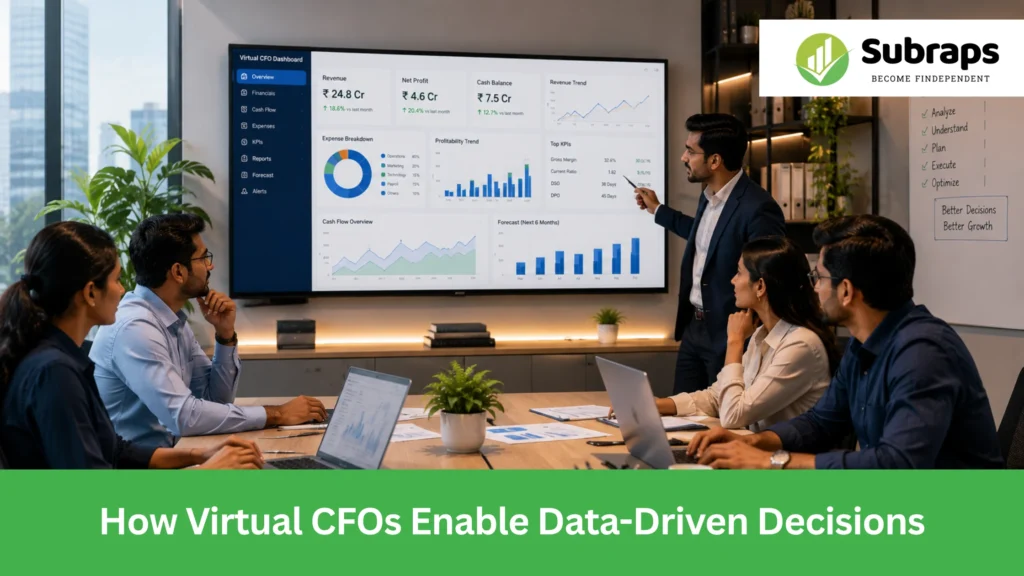
Most business decisions don’t fail because the idea is wrong; they fail because the numbers arrive too late.
In a business environment where costs shift quickly, competition is constant, and customer demand can change without warning, intuition alone becomes a risky way to lead. Even good instincts can be misleading when financial realities stay hidden under delayed reporting, incomplete visibility, or unclear metrics.
Businesses that consistently perform better usually operate with one advantage: they make decisions using accurate financial data, interpreted correctly and applied at the right time. That is what turns finance from a record-keeping function into a decision-support function.
This is where Virtual CFOs (Chief Financial Officers) make a measurable difference. A Virtual CFO brings senior finance leadership without the cost of hiring a full-time executive. More importantly, they help businesses build a decision system, one where financial data is not only recorded but translated into actionable direction. When leaders can see what is happening, why it is happening, and what is likely to happen next, decisions become faster, clearer, and less risky.
Understanding the Role of a Virtual CFO
A Virtual CFO steps in as senior finance leadership, but in a flexible, outsourced model. Think of traditional accounting as the foundation; it keeps records clean, ensures compliance, and maintains financial order. A Virtual CFO builds on that foundation by using the numbers to support business direction.
Their role is less about producing statements and more about strengthening decisions. They interpret performance, spot patterns early, and connect financial outcomes to actions that protect cash flow, improve profitability, and support sustainable growth.
The real difference is not whether financial data is available most businesses already have it. The difference is whether the data becomes usable. A Virtual CFO works directly with founders and leadership teams to turn financial information into a practical management tool. Instead of stopping at “Are the numbers correct?” they answer “What do these numbers mean for us?” and “What should we do next?” That is what shifts finance from reporting to leadership support.
Turning Financial Data into Strategic Insights
A Virtual CFO converts data into insight using a simple discipline:
- Read beyond totals
Reports show totals, but totals don’t explain performance drivers. - Link numbers to business activity
Revenue growth is checked against margin health, pricing decisions, cost movement, and delivery efficiency. - Identify what to change
Leaders get clear signals on where to invest, where to fix leaks, and what to stop funding before losses grow.
This creates practical clarity, so decisions are made early, not after underperformance becomes visible.
Improved Forecasting and Budgeting
Leaders can’t run a business only by looking at last month’s numbers. Data-driven decisions require forward visibility, such as what cash, costs, and performance will look like if conditions change.
Forecasting: turning today’s drivers into tomorrow’s outcomes
Virtual CFOs build forecasts based on real operating variables, not assumptions. That includes revenue drivers, cost behaviour, working capital movement, and cash collection cycles. The forecast becomes useful when it answers “what-if” questions that affect stability:
- If collections slow by 30 days, cash tightens even when revenue looks strong.
- If hiring increases before revenue stabilizes, burn rises, and the runway reduces.
- If vendor costs rise or expansion adds overhead, margins fall unless pricing and efficiency are protected.
A Virtual CFO models these scenarios so leadership can choose options that are realistic and financially safe.
Budgeting: converting plans into control
With the same discipline, budgeting becomes more than an annual spreadsheet. It becomes a working decision tool, spending is tied to priorities, performance is reviewed against the plan, and adjustments are made early. This reduces surprise shortfalls and improves predictability across operations.
Real-Time Performance Tracking
The problem: Month-end reporting comes too late. Issues often start quietly, collections slow, costs creep up, margins dip, or the revenue mix changes. When the report finally confirms it, the best window to respond is already gone.
The fix: Virtual CFOs set up tracking that improves visibility during the month, not after it. Dashboards and KPIs are built to highlight decision signals, not overwhelm leaders with extra data.
What gets tracked most often:
- Cash position and runway
- Collection speed and receivables quality
- Gross margin movement
- Operating expense efficiency
How it runs: Performance is reviewed regularly, variances against the plan are flagged, the drivers behind the variance are explained, and corrective actions are taken early, creating tighter control and reducing reactive pressure.
Supporting Smarter Growth Decisions
Growth decisions carry financial risk because they usually involve upfront costs before returns appear. Hiring, entering a new market, launching a new product, increasing marketing spend, or investing in systems can all strain cash flow if not evaluated carefully.
A Virtual CFO strengthens growth decisions by ensuring they are backed by analysis, not optimism. Leadership teams can evaluate growth using structured financial logic, quantifying break-even points, estimating ROI, mapping payback timelines, and assessing the real cash flow impact.
This ensures leaders do not only ask whether growth will increase revenue but also whether it will improve profitability, maintain stability, and stay aligned with long-term objectives. When growth is evaluated through data, businesses avoid the trap of scaling faster than cash flow allows. Growth becomes sustainable, strategic, and less disruptive.
Building Investor and Stakeholder Confidence
When a business speaks with investors, lenders, or strategic stakeholders, financial clarity acts as a credibility signal. Many funding and partnership discussions break down not because the business lacks potential, but because reporting is inconsistent, numbers are hard to explain, or performance cannot be defended with confidence.
A Virtual CFO reduces that risk by putting structure around financial communication. Reporting becomes consistent, accurate, and ready for scrutiny. Performance is explained in a way that stakeholders can follow and validate, not just accept. They also prepare the business for due diligence by keeping metrics consistent, strengthening supporting documentation, and building forecasts that can be explained logically. Over time, this level of transparency improves trust and makes stakeholder relationships easier to maintain.
Conclusion
Virtual CFOs are not just financial advisors. They operate as strategic partners who enable data-driven decision-making across the organization. By converting financial data into actionable insight, improving forecasting and budget discipline, building real-time performance visibility, and supporting growth decisions through ROI and cash impact analysis, Virtual CFOs help leaders make smarter choices with greater confidence.
If your reports arrive after decisions are already made, the most practical next step is to strengthen the decision system itself: define the KPIs that reflect business health, build a forecasting rhythm that explains cash outcomes, and standardize reporting so leaders can act early, not react late. A Virtual CFO helps structure this approach so financial data becomes direction, and direction becomes measurable results. If you need leadership-ready reporting, request a finance decision pack setup, a KPI dashboard, cash runway tracker, and a forecast model tailored to your business so decisions stay timely and measurable.
