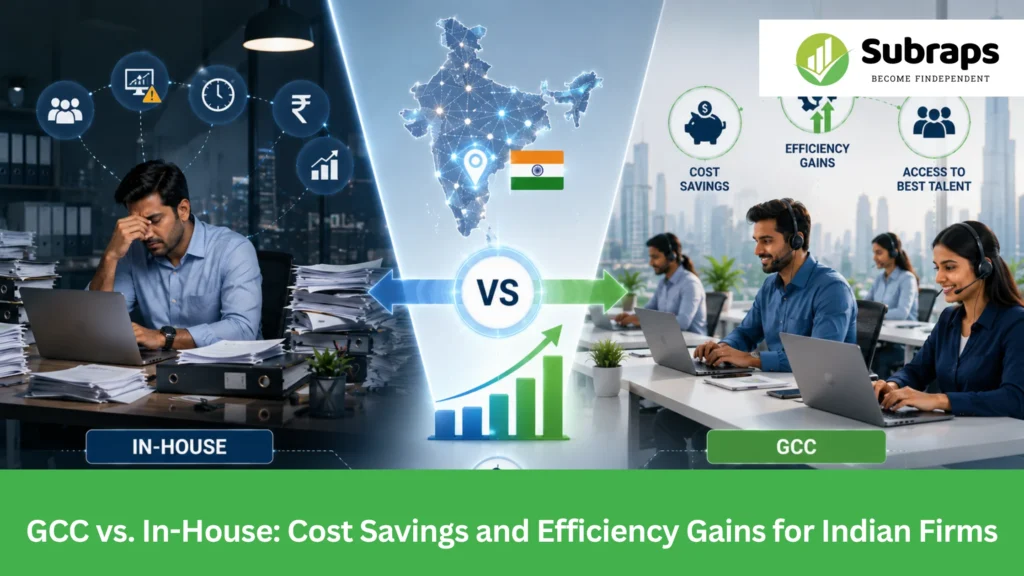
Growth doesn’t get expensive because you scale; it gets expensive when your operating model stays the same while everything else expands.
Indian firms that scale fast often discover a tough truth: growth is easy to plan, but expensive to execute. New markets, new customers, and bigger product lines increase workload across finance, analytics, technology, HR, and support. The real question becomes: do we keep building everything in-house, or do we scale using a Global Capability Center (GCC) model?
This decision is no longer a “back office” discussion. It changes your total cost of ownership, hiring velocity, execution consistency, risk exposure, and time-to-scale.
And the timing is right. India has become a major GCC base globally, often cited at 1,700+ GCCs, employing about 1.9 million professionals, generating around $64.6B in revenue (FY2024), with projections reaching $99–$105B by 2030.
This blog guides you through what the GCC model really changes, when it makes sense, and how to evaluate it before you scale.
A quick scenario to make this real
Growth looks great on paper until the operating engine starts overheating. Close gets delayed, reports don’t match across units, analytics gets buried in urgent requests, and specialist hiring drags for months. Leaders demand faster visibility and stronger controls, but every fix adds cost.
That’s when the question shifts: which model improves speed and accuracy while reducing cost per output?
Understanding the two models in Simple Terms
In-house model
In-house means the company builds and manages teams inside the core organization. You own hiring, reporting lines, processes, tools, and compliance directly.
It usually performs best when:
- The work requires constant proximity to business leadership
- The volume is low, but the complexity is high
- Decision-making must remain tightly controlled
GCC model
A GCC is a dedicated delivery center that supports specialized services (finance operations, analytics, technology, HR, engineering, customer support). It can be captive (owned) or supported with a strategic partner.
It usually performs best when:
- The work is repeatable and measurable
- The output volume grows faster than the internal capacity
- You need niche skills at scale without constant rehiring
Definition block: the metric that makes the comparison fair
Definition for Unit Cost
Unit cost = Total cost ÷ Outputs delivered
If you compare only salaries, you miss the real drivers of efficiency. A fair comparison looks like:
- Cost per invoice processed
- Cost per month-end close activity
- Cost per report pack delivered
- Cost per reconciliation completed with first-pass accuracy
This is where the model choice becomes obvious, because it connects cost, productivity, and quality.
Cost structure: where savings actually come from
The in-house cost curve (why it climbs faster than expected)
In-house scaling increases fixed costs and hidden costs at the same time.
Fixed costs are visible:
- Office expansion and infrastructure
- Managerial layers and support functions
- Benefits and long-term people commitments
Hidden costs show up later:
- Rework when outputs are inconsistent
- Delays caused by handoffs and approvals
- Duplicated work across teams
- Attrition backfill cost + knowledge loss
As the organization grows, these costs compound. Many teams are strong individually, but the system becomes fragmented.
The GCC cost curve (why unit economics can improve)
GCCs are typically set up to reduce cost through standardization and scale economics, not only payroll arbitrage. They often deliver better unit costs because:
- Workflows are designed to be repeatable
- Capacity planning is tied to demand and service metrics
- Shared services reduce duplication across functions
- Governance forces clarity on ownership and deliverables
Stat spotlight: Benchmark discussions often cite ~30%–50% cost advantages in GCC-led delivery (depending on function and design), especially when processes are standardized and centers leverage cost-optimized locations.
Reality check: Savings don’t happen just because work is “moved.” Savings happen when outputs are defined, handoffs are reduced, and rework drops.
Comparison table: what changes in day-to-day execution
| What you’re optimizing | In-house model | GCC model |
| Cost base | Higher fixed overhead as you grow | Lower structural cost base when standardized |
| Hiring speed | Constrained by location and competition | Wider hiring funnel + scalable pipelines |
| Output consistency | Depends on team maturity | More process-led delivery, measurable SLAs |
| Productivity | Often impacted by silos and rework | Higher throughput when workflows are repeatable |
| Scaling | Slower due to space + support layers | Faster ramp with less disruption |
| Continuity | Higher key-person + location risk | Better documentation + cross-training |
Talent access: a cost problem disguised as a hiring problem
Many firms treat hiring as an HR challenge. It’s not. It is a cost and execution stability issue.
When niche skills are scarce (AI, cloud, cybersecurity, advanced analytics), in-house delivery often faces:
- Longer time-to-hire → delayed delivery and opportunity cost
- Wage inflation → higher steady-state costs
- Higher churn risk → repeated backfill and onboarding cost
GCCs often improve predictability because talent strategies can be built around scale: campuses, training pipelines, structured upskilling, and role-based progression. That reduces overdependence on expensive lateral hiring and improves forecasting accuracy.
Operational efficiency: the quiet difference between “busy” and “productive”
A typical in-house cycle looks like this: a report request comes in, the data sits with one team, validation happens with another, formatting is done elsewhere, and approvals take the longest. Everyone works hard, but the output still arrives late or comes back for correction. That is what “busy” looks like. It’s movement without momentum.
In a well-run GCC setup, the same work feels different. Ownership is defined from start to finish, standards don’t change by team, and review checkpoints prevent issues before they reach leadership. With repeatable workflows and automation-first design, productivity becomes predictable. The difference is not speed alone; it is fewer correction loops and fewer follow-ups.
Callout: Track rework rate like a financial metric. Every correction cycle consumes senior review time and delays decisions, even when headcount stays the same.
If you need a compact scorecard, keep it to four measures: cycle time, first-pass accuracy, rework rate, and unit cost per output.
Scalability and flexibility: protecting unit costs during expansion
From a cost perspective, scaling in-house increases both fixed commitments and coordination overhead. Beyond hiring, the organization must absorb added management layers, infrastructure, internal support, and governance effort. As complexity grows, the cost per output can rise even if individual teams remain productive, simply because more time is spent on alignment and handoffs.
GCCs often preserve scalability with better cost discipline because additional capacity is added within a structured delivery model. Standard workflows make expansion repeatable, and measured output expectations reduce the operational drag that typically appears during rapid growth. This becomes especially valuable during geography expansions, transformation programs, acquisition integration, and rising compliance/reporting requirements, situations where the organization needs speed without sacrificing consistency.
Market trajectory aligns with this reality. India’s GCC ecosystem is projected to expand further by 2030 in centers, talent base, and economic contribution, indicating sustained enterprise reliance on scalable delivery models.
Risk management and continuity: the overlooked part of the business case
When everything sits in-house, risk concentrates:
- Localized disruptions hit harder
- Attrition spikes can break delivery
- Inconsistent documentation increases dependency risk
GCC models can reduce concentration risk through:
- Standardized documentation
- Cross-trained teams and backups
- Defined ownership and delivery governance
This resilience factor is one reason GCCs have evolved from “cost centers” into critical operating layers for many global and India-focused firms.
Strategic value beyond cost: the “capability ladder” effect
Think of a GCC as climbing a ladder. On the first rung, it delivers capacity, and work gets completed with speed and consistency. That is useful, but it is not the full return. Real ROI appears when the center climbs to higher rungs, where it starts creating capability the core business can reuse again and again.
At the next stage, the GCC becomes a builder of better ways of working. Automation moves from isolated scripts to repeatable automation patterns. Process improvement becomes continuous, not occasional. Analytics shifts from producing numbers to producing faster, decision-ready insights. In more mature setups, the center also begins contributing to product or platform delivery, while tightening standardized reporting and control discipline so outcomes remain consistent even as volume grows.
While that maturity develops, the core organization still plays a different role. Strategic leadership, stakeholder alignment, and decisions that require real-time business context must stay close to the business. These responsibilities are not “transferable execution”; they are ownership and judgment.
That is why the strongest design is often a hybrid. The organization keeps strategy and leadership accountability in-house, and uses the GCC to scale repeatable execution and capability-building—so value grows not only through cost reduction, but through faster execution, better decisions, and stronger operating discipline.
Conclusion
For Indian firms competing on a global stage, a GCC can be more than a cost lever; it can become an execution engine. The biggest gains show up when the model improves unit economics while also raising consistency: standardised workflows, higher productivity, faster cycle times, and resilience that doesn’t break when volume spikes or talent shifts. With India’s GCC ecosystem already mature and still growing toward 2030, the opportunity is real, but only if the decision is made with operating math, not assumptions.
If you are choosing between a GCC and an in-house build, start with baselines you can measure: your current total cost structure (fixed + variable), unit cost per output (invoice, close task, report pack, reconciliation), cycle time, and rework rate. Then model a 12–18 month scenario that includes transition and governance, so leadership can approve the direction with confidence because it is tied to outcomes, not opinions.
Want to validate your GCC vs. in-house decision with a clear, numbers-backed business case? Talk to our team, we’ll help you map your baselines, build a 12–18 month model, and identify the fastest, lowest-risk path to scale.
