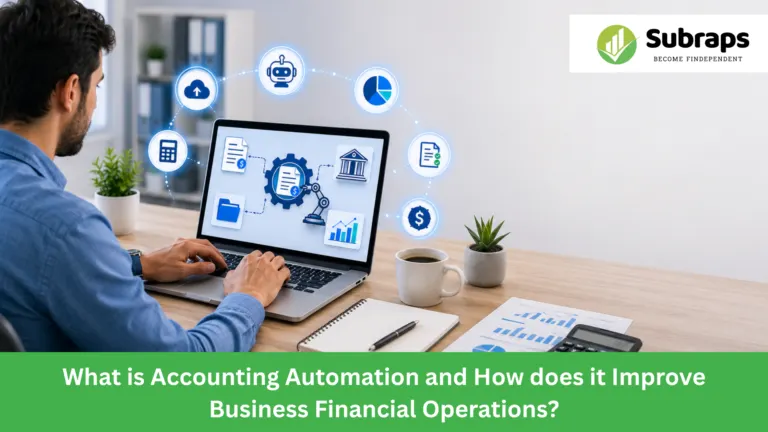
Are routine accounting tasks slowing down your finance team? Many businesses still rely on manual processes to manage invoices, payments, reconciliations, and financial reporting. As transaction volumes increase, these tasks can take up valuable time, lead to errors, and limit visibility into cash flow and financial performance. When finance teams spend most of their time on routine accounting activities, they have less time to focus on financial planning and business decisions. Accounting automation helps address these challenges by reducing accounting processing time, improving reporting accuracy, and providing better visibility into financial data. This enables finance teams to support informed decision-making and business growth.
What is Accounting Automation?
This technology-driven approach helps businesses streamline routine accounting and finance activities with minimal manual effort. It automates processes such as invoice processing, expense tracking, payment approvals, account reconciliations, and financial reporting automation, reducing the need for repetitive administrative tasks. As part of end-to-end finance automation solutions, these capabilities help organizations simplify financial processes and improve operational efficiency.
Instead of relying on spreadsheets and manual workflows, organizations can use automated financial systems to process information more efficiently while maintaining accurate and up-to-date records. This improves workflow efficiency, enhances data accuracy, and provides finance teams with greater visibility into financial performance and overall financial operations.
Key Challenges Businesses Face with Manual Accounting
Manual accounting processes can create significant challenges for growing organizations and reduce the efficiency of overall financial operations. Activities such as invoice processing, expense management, payment approvals, reconciliations, and financial reporting often require substantial manual effort.
As transaction volumes increase, businesses may face reporting delays, duplicate entries, approval bottlenecks, and inconsistent financial records. These issues can affect productivity, compliance, and decision-making while making it difficult to maintain accurate financial data.
Without efficient systems in place, finance teams often spend more time managing transactions than delivering insights that help drive business growth.
Signs Your Business Needs Accounting Automation
Does your business face any of these challenges? If your finance team regularly experiences one or more of the issues below, it may be a sign that your current accounting processes are no longer efficient or scalable.
- Invoice processing takes too long.
- Finance teams spend excessive time on manual data entry.
- Month-end closing is frequently delayed.
- Financial reports are difficult to generate quickly.
- Accounting errors occur regularly.
- Cash flow visibility is limited.
- Approval workflows create bottlenecks.
- Transaction volumes are increasing faster than financial resources.
If your business is facing one or more of these challenges, it may be time to replace repetitive accounting tasks with automation. This can help reduce accounting processing time, improve reporting accuracy, and provide better visibility into financial performance.
Why do Businesses Need Accounting Automation?
As businesses expand, the number of invoices, payments, expenses, and reporting requirements grows significantly. Managing these activities manually can become time-consuming and difficult to scale.
Finance teams often spend hours on repetitive tasks such as data entry, invoice matching, approval routing, and reconciliations. These activities can slow financial processes, increase operational costs, and reduce the time available for financial planning and analysis.
Finance automation services help businesses eliminate repetitive tasks, improve workflow consistency, and provide greater visibility into financial performance. By reducing manual effort and improving process efficiency, organizations can enhance reporting accuracy, maintain stronger financial control, and access more reliable financial information.
How does Accounting Automation Support Business Financial Operations?
Businesses can improve financial operations through financial workflow automation, which streamlines routine processes and improves the flow of financial information across departments.
For example, when an invoice is received, an automated workflow can capture the data, validate information, route it for approval, and record it within the accounting system. Similar processes can be applied to expense management, payment processing, account reconciliations, and report generation.
By creating standardized workflows, businesses can reduce delays, improve accuracy, and maintain reliable financial records. This ensures that critical financial information is available when needed to support daily operations and decision-making.
Accounting Processes that can Be Automated
These solutions can help businesses simplify and manage a wide range of financial activities, including:
Invoice Processing Automation
Automate invoice capture, validation, approvals, and recording while reducing processing delays.
Accounts Payable Automation
Simplify vendor payments, approval workflows, and payment tracking.
Accounts Receivable Automation
Improve customer invoice management, collections, and cash flow visibility.
Expense Management Automation
Automate expense submissions, approvals, reimbursements, and compliance monitoring.
Bank Reconciliation Automation
Automatically match transactions and reduce reconciliation time.
Financial Reporting Automation
Generate reports faster while improving consistency and accuracy.
Key Benefits of Accounting Automation
Reduced Accounting Errors
Minimizing manual data entry helps businesses maintain more accurate financial records.
Faster Financial Processes
Automation accelerates invoice processing, approvals, reconciliations, and reporting activities.
Improved Finance Team Productivity
Finance professionals can focus more on planning, forecasting, and analysis rather than repetitive administrative tasks.
Greater Financial Visibility
Access to organized and real-time financial information provides better insight into business performance and cash flow.
Stronger Financial Control
Standardized workflows help improve governance, compliance, and oversight of financial activities.
Better Decision-Making
Reliable financial data enables business leaders to make informed decisions with confidence.
Scalable Financial Operations
As organizations grow, finance process automation helps manage increasing transaction volumes without significantly increasing manual workloads.
Business Outcomes of Investing in Accounting Automation
The benefits extend beyond improving day-to-day workflows. Businesses can complete financial tasks more quickly, gain a clearer view of their cash position, speed up month-end activities, and access key financial information on demand. This helps teams make better decisions, reduce manual effort, improve accuracy, and focus more on supporting business growth and long-term goals.
With better access to accurate financial information, finance teams become more productive, reporting becomes more reliable, and leadership gains a clearer understanding of business performance. These improvements help organizations create a stronger financial foundation for sustainable growth.
Why Choose Subraps?
At Subraps, we help businesses transform manual accounting processes into automated financial workflows. Our finance automation solutions are designed to reduce accounting processing time, improve reporting accuracy, strengthen financial control, and provide better visibility into financial performance.
We work closely with organizations to identify process bottlenecks and implement automation strategies tailored to their business needs. By combining accounting expertise with modern automation technologies, we help businesses reduce manual workloads, improve access to financial information, and build scalable finance processes.
Whether your goal is to automate invoice processing, improve financial reporting, streamline approvals, or optimize finance operations, Subraps delivers finance solutions that support informed decision-making and sustainable business growth. Contact us today to learn how we can help transform your accounting processes into a more efficient and scalable finance function.
Conclusion
Accounting automation helps businesses simplify financial processes, reduce manual workloads, and improve the efficiency of financial operations. By automating routine accounting tasks, organizations can improve reporting accuracy, strengthen financial control, and gain greater visibility into business performance.
As financial demands continue to increase, investing in accounting process automation enables businesses to improve productivity, make better decisions, and build scalable finance operations. By adopting automated accounting workflows, organizations can create a more efficient, data-driven, and future-ready finance function.
