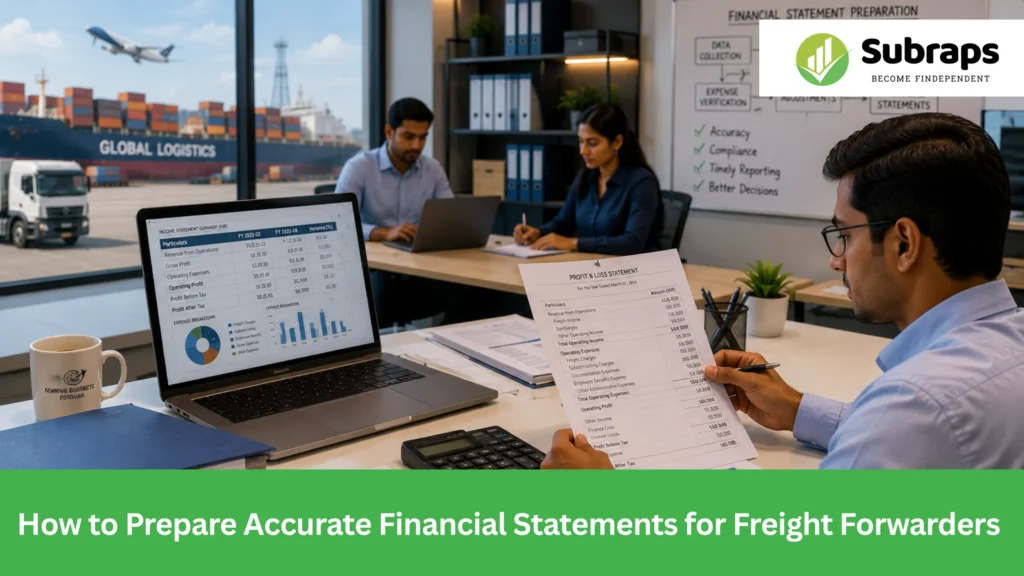
Freight forwarding is one of those businesses where activity looks “busy” every day, but the numbers don’t always look “clean” at month-end. Shipments cross months. Invoices arrive late. Exchange rates move. Vendors bill differently for the same lane. And one missing document can shift profit from one period to the next.
That’s why accurate financial statements in freight forwarding are not just about bookkeeping. They are about matching revenue to the right shipment, capturing true costs, and presenting results in a way that helps you answer the questions leadership cares about:
- Are we profitable by customer, lane, and shipment type?
- Which jobs are leaking margin?
- Are accruals reliable, or are we “guessing” at close?
- What is our real cash position, not just bank balance?
This blog walks you through a practical, freight-forwarder-friendly approach to producing accurate P&L, Balance Sheet, and Cash Flow every month, without difficulties.
Why Freight Forwarding Financial Statements Go Wrong
Most inaccuracies come from timing and data gaps, not from effort. Freight forwarding has a few patterns that cause consistent reporting issues:
1) Revenue recognized before the job is actually complete (or delayed too long)
When revenue is booked at invoice time instead of milestone completion, you get month-to-month swings that don’t reflect operations.
2) Direct costs arrive late
Carrier bills, handling charges, and terminal invoices often land after month-end. If you don’t accrue them correctly, margins look inflated and then “drop” next month.
3) WIP and unbilled revenue are not tracked shipment-wise
Without job-level logic, “work-in-progress” becomes a vague bucket instead of a controlled schedule.
4) FX and multi-currency aren’t consistently handled
If rates vary across AR/AP posting, revaluation, and settlement, you’ll see unexplained gains/losses.
5) Documentation is scattered
A shipment’s commercial invoice, DO, BL/AWB, vendor bills, and customer invoice may live in different places. That makes reconciliation slow and error-prone.
Before You Close: Set the Foundation
Accurate statements come from repeatable inputs. If your month-end depends on chasing people, accuracy becomes luck.
Build a shipment-to-ledger structure
Whether you use TMS/ERP or spreadsheets, you need a consistent “spine” that ties the operational world to accounting. At a minimum, every job should have:
- Job/Shipment ID (unique and consistent)
- Customer
- Mode (Air/Ocean/Road), Import/Export
- Key dates (ETD/ETA, job completion date)
- Billing status (billed/unbilled)
- Cost status (received/expected)
- Currency and exchange rate policy
When this structure exists, your close stops being “accounting-only” and becomes operations + finance aligned.
Standardize your chart of accounts for freight logic
Freight statements become clearer when income and costs are grouped in a way that matches how the business operates.
For example:
- Revenue: Freight income, handling, documentation, customs, other pass-through
- Direct costs: Carrier freight, THC, CFS, local transport, agent charges, brokerage pass-through
- Operating expenses: staff, rent, software, marketing, admin, finance costs
The goal is simple: direct costs should be separable from overhead so job margin remains meaningful.
Step-by-Step: Month-End Close Process for Freight Forwarders
Step 1: Lock the shipment list for the period
Start by extracting all shipments that fall into the reporting month based on a consistent rule, typically job completion date or delivery milestone.
For freight forwarders, a common approach is the following:
- Treat a job as “complete” when the service obligation is substantially fulfilled (e.g., cargo delivered / key milestone met).
- Recognize revenue and costs aligned to that milestone.
Whatever your rule is, document it and apply it consistently.
Output you want: A shipment register that lists “in-month completed” jobs and “in-progress” jobs.
Step 2: Reconcile billing status (AR readiness)
Now separate your shipment register into:
- Billed shipments (customer invoice raised)
- Unbilled but completed shipments (service complete, invoice pending)
This is where accuracy improves dramatically.
If a job is complete but not billed, your statements will understate revenue unless you record unbilled revenue / accrued income.
Good practice: Create a monthly “Unbilled Revenue Schedule” with shipment ID, customer, expected billing amount, and supporting proof (quote, rate confirmation, job sheet).
Step 3: Capture direct costs correctly (AP readiness + accruals)
Costs in freight forwarding arrive from multiple sources, carriers, agents, CFS, transporters, customs brokers, and terminals. Many of these are delayed, but the job margin must still be correct for the period.
Split costs into:
- Booked vendor bills (in AP)
- Expected but not received bills (accrual needed)
To accrue accurately, do not use a single lump-sum guess. Build accruals shipment-wise:
- Shipment ID
- Vendor type (carrier/agent/THC/etc.)
- Expected cost amount
- Basis (rate sheet, prior invoice, contract, email confirmation)
This becomes your “Accrued Direct Cost Schedule.”
Step 4: Handle pass-through charges without inflating margin
Freight forwarders often bill customers for charges that are essentially pass-through (customs duty advances, local fees). If posted incorrectly, the P&L looks bigger, but the margin looks confusing.
Two clean approaches:
- Gross method: record revenue and matching cost separately (recommended if you manage service + pricing).
- Net method: record only the margin portion when you are a pure agent and the accounting policy supports it.
Choose one policy, document it, and stay consistent. The key is that your financial statements should reflect true value added, not just transaction volume.
Step 5: FX and multi-currency: apply one policy, every month
Freight forwarding is naturally multi-currency. Accuracy improves when you follow a fixed rule set:
- Use a defined exchange rate source (bank rate, RBI reference, system rate, etc.)
- Use transaction date rate for initial posting (invoice/bill date)
- Revalue foreign currency balances at month-end for AR/AP and bank balances
- Record FX gain/loss separately so it doesn’t hide inside job margins
Practical tip: Keep job profitability analysis in a “base currency view” using consistent conversion logic, otherwise comparing margins across jobs becomes misleading.
Step 6: Reconcile key balance sheet accounts (non-negotiable)
Freight forwarders often focus heavily on P&L and ignore balance sheet hygiene. But inaccuracies usually live here.
At a minimum, reconcile these monthly:
Accounts receivable (AR):
Match customer statements and aging. Identify credit notes pending, disputes, and old balances.
Accounts payable (AP):
Confirm vendor balances, missing invoices, and debit notes.
Accrued expenses (shipment accruals):
Ensure accrual reversals happen when bills arrive, and expenses are double-counted.
Unbilled revenue / WIP:
Confirm that items move out once invoiced.
Advances and deposits:
Separate customer advances, vendor advances, and employee advances clearly.
Bank + cash:
Tie to bank statements and ensure timing differences are documented.
Accuracy is not “we think it’s right.” Accuracy is reconciled and supported.
The Freight-Forwarder P&L: What a “Good” P&L Should Show
A freight forwarding P&L should allow you to answer:
- Gross profit by core services
Freight income less direct shipment costs. - Operating profitability
Gross profit less overheads. - Separate visibility for FX effects
So operational performance isn’t confused with currency movement.
If your P&L cannot explain margin movement month-to-month, it’s a sign that accruals, unbilled revenue, or classification are inconsistent.
Use Job Profitability as a Control, Not Just a Report
- Pull the completed shipment list for the month
Use your job register and freeze the set of shipments that are considered “completed” in the reporting period. - Check that revenue is recorded for every job
Confirm each completed shipment has revenue captured either through a customer invoice or an unbilled revenue entry if billing is pending. - Check direct costs are recorded for every job
Confirm the key shipment costs are captured either as posted vendor bills or as accruals when vendor invoices haven’t arrived. - Identify margin exceptions
Filter jobs with unusually high margins or negative margins. These are the ones that need review. - Investigate the root cause
Common issues include missing costs, wrong rate applied, duplicate posting, FX mismatch, or wrong customer/job mapping. - Repeat this control every month
When this becomes a standard monthly control, job profitability stays reliable and your financial statements stop drifting.
Common Mistakes That Cause Inaccurate Freight Financials
Here are the mistakes that show up repeatedly (and how to avoid them):
- Revenue booked on invoice date only – Fix with unbilled revenue tracking tied to job completion.
- Costs booked only when vendor bills arrive – Fix with shipment-wise accruals.
- Accruals never reversed – Fix with a reversal and matching process.
- Pass-through charges treated inconsistently – Fix with one accounting policy and COA discipline.
- AR and AP not reconciled monthly – Fix with a monthly reconciliation calendar and ownership.
- Too much dependence on spreadsheets with no controls – Fix with templates, approvals, and versioning until systems improve.
A Simple Close Timeline That Works
If your team needs a repeatable rhythm, this pattern is realistic:
- Day 0–1: Shipment register finalized + billing status review
- Day 2–3: Direct cost capture + accrual schedule prepared
- Day 4: AR/AP reconciliations + bank reconciliation
- Day 5: Review margins + management P&L finalization
- Day 6: Final statements pack + leadership insights
The point is not the exact day count. The point is that each output has an owner and a cut-off.
Final Review Checklist: How to Know Your Statements Are Accurate
Before publishing statements, run these “sanity checks”:
- Do revenue and completed shipments move in the same direction?
- Are gross margins consistent with the lane/service mix?
- Are accrual balances stable and explained month-to-month?
- Does unbilled revenue convert into billed revenue next period?
- Are AR and AP aging aligned with actual collections and vendor payments?
- Is FX gain/loss reasonable relative to exposure?
- Can every large balance sheet item be supported by a schedule?
If you can answer “yes” without guesswork, your statements are strong.
Conclusion
Accurate financial statements in freight forwarding come from running month-end close the same way the business runs, shipment by shipment. When revenue, direct costs, accruals, and billing status are consistently linked to job-level data, your numbers become stable and explainable, margins reflect real performance, and leadership can trust profitability insights without month-end surprises or last-minute corrections.
Want to tighten your close and make job profitability reliable? Share your current close steps (even if it’s rough). I’ll restructure it into a shipment-wise month-end framework with clear schedules for accruals and unbilled revenue, plus a practical review checklist your team can follow every month.
