If your finance team is constantly firefighting, late reconciliations, month-end surprises, repeated rework, and audit evidence hunted down at the last minute, your issue usually isn’t effort. It’s the operating model.
Global Capability Centres (GCCs) are no longer set up only to reduce cost. In finance and accounting, they’re increasingly used to create repeatable execution, consistent controls, and scalable delivery. Many large enterprises run at least one GCC that supports finance/shared services, and newer finance GCCs are often designed around workflow controls and automation, not large manual teams.
Accounting back-office work is usually the first function to move into a GCC because it’s documentation-heavy, rules-based, and measurable. When processes are standardised, and ownership is clear, organisations often see faster closes and better audit readiness, not because work disappears, but because execution becomes predictable.
This guide breaks down how to build an accounting back-office GCC in a practical, structured way.
What Is an Accounting Back-Office GCC?
An accounting back-office GCC is a centralised team that supports routine accounting execution while finance leadership retains decision-making and accountability. Its role is to bring consistency to daily accounting work so records remain clean, traceable, and review-ready.
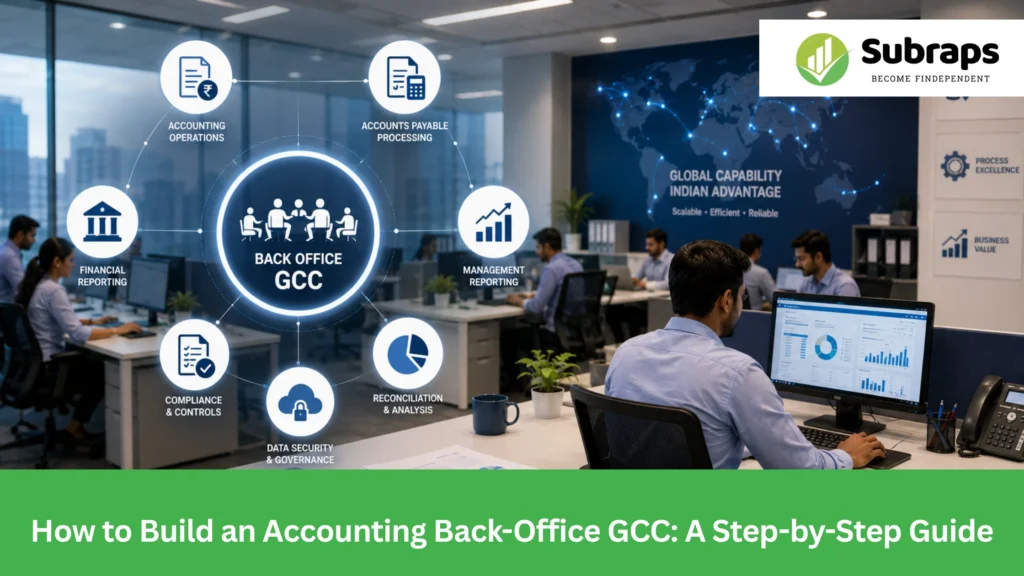
Typical scope handled by an accounting GCC
- Supplier bill processing and validation support.
- Customer invoicing and payment tracking support.
- Journal entry preparation based on predefined rules.
- Bank, vendor, and customer reconciliations.
- Month-end close preparation and checklist execution.
- Audit documentation and evidence support.
The GCC focuses on execution discipline, not judgment or policy interpretation.
Step 1: Decide Why You Want a GCC
Every successful GCC starts with a single, clear objective. Without this clarity, scope creep and ownership confusion appear quickly.
Most organisations build accounting GCCs to:
- Reduce delays in daily accounting tasks.
- Remove inconsistencies across locations.
- Lower error rates caused by manual handling.
- Free senior finance teams from execution work.
- Create a scalable operating model as volumes grow
At this stage, it is equally important to define what will not move to the GCC. Final approvals, policy decisions, and statutory sign-off typically remain with senior finance leadership.
Step 2: Define Scope Using a Three-Layer Model
Layer 1: Execution work (ideal for GCC)
Rule-based, repeatable activities with clear inputs and outputs.
Layer 2: Review work (shared ownership)
Prepared by the GCC, reviewed by finance leadership.
Layer 3: Judgment work (retain locally)
Policy interpretation, exceptions, and regulatory decisions.
This layered approach prevents confusion and keeps accountability intact.
Step 3: Choose the Right Location
| Factor | What to Look For | Why It Matters |
| Talent availability | Strong accounting hiring pool | Reduces dependency on constant training |
| Communication | Clear written and spoken business English | Avoids rework and misunderstandings |
| Time-zone overlap | At least partial overlap | Enables faster approvals |
| Attrition trends | Stable retention | Preserves process knowledge |
| Data environment | Strong security culture | Protects financial data |
| Cost | Sustainable, not lowest | Stability matters more than savings |
A location that is cheap but unstable will increase long-term risk and cost.
Step 4: Decide How the GCC Will Operate
A GCC works only when ownership is clearly defined. The team can execute day-to-day accounting tasks, but finance leadership must still own the outcomes and accountability. Escalations should follow predefined paths so issues are raised early, not discovered at month-end. Performance should also be reviewed consistently based on quality and timeliness, not just volume handled.
For every major accounting process, define three things upfront: who prepares the work, who reviews it, and who approves it. This clarity prevents “I thought someone else handled it” situations and keeps execution predictable.
Step 5: Set Up Review and Control
- Separate preparation and review by implementing a maker–checker structure.
- Protect against control risk by enforcing the separation of duties across key activities.
- Clarify decision rights using approval limits and an authority matrix.
- Stabilise quality through regular quality reviews and error trend checks.
- Avoid last-minute surprises with an early escalation mechanism and clear triggers.
- Make close predictable by establishing a month-end governance rhythm.
- Control urgency safely by defining how urgent exceptions are handled without bypassing approvals.
When these elements are in place, audit readiness improves, and month-end becomes less stressful.
Step 6: Hire the Right People
Do
Hire people with strong accounting fundamentals, system familiarity, and clear communication skills. Look for teams that document work carefully and follow structured processes.
Don’t
Rely only on years of experience, skip system exposure, or ignore retention patterns. High attrition quickly erodes GCC quality.
Training should focus on process understanding, not just task execution.
Step 7: Fix and Standardise Processes Before Transition
Before:
Different teams follow different approval flows. Exceptions are handled informally. Month-end relies on individual memory.
After:
One standard workflow, documented steps, clear exception rules, and shared evidence storage.
A simple rule applies here: never move a broken process into a GCC.
Step 8: Use Tools to Reduce Manual Work
System of record: Your ERP/accounting platform must stay as the single source of truth.
Flow control: Workflow + approvals should route every task through a defined path, not email threads.
Traceability: A ticket/request tracker should log ownership, timestamps, and status for every request.
Repeat-task relief: Simple automation should handle high-volume, repetitive steps with minimal human touch.
Visibility layer: Dashboards should show backlog, SLA status, and bottlenecks in real time.
Security guardrails: Role-based access should match duties, approvals, and risk levels.
Typical automation wins include invoice routing, payment matching, and month-end checklist tracking. The target is fewer manual touchpoints and clearer visibility.
Step 9: Keep Work Safe and Audit-Ready
Accounting GCCs must be designed with compliance in mind.
- No single person prepares and approves the same work
- All actions are logged with timestamps
- Evidence is stored centrally and consistently
- Access is reviewed periodically
- Critical tasks require dual review
These controls protect both the organisation and the GCC team.
Step 10: Track Results and Improve Gradually
Once stable, performance should be measured using a small set of indicators:
- Turnaround time by task type.
- First-pass accuracy.
- Rework frequency.
- Backlog ageing.
- Month-end close adherence.
- Internal stakeholder feedback.
Expansion into deeper reporting or analysis support should happen only after core stability is achieved.
Build a Culture of Ownership
When the GCC is treated as part of the finance organisation, the quality of execution improves because accountability is shared. When communication is clear, rework reduces. When quality is recognised, documentation discipline strengthens. And when the team interacts regularly with finance leadership, escalations become earlier, and outcomes become more predictable. Over time, this creates an ownership culture where the GCC is measured by results, not just activity.
Quick Pre-Launch Check
Go-live should happen only after the essentials are locked: documented purpose and scope, clear task ownership, established controls and reviews, completed SOPs and training, configured tools and access, and a planned parallel run.
Conclusion
An accounting back-office GCC is a long-term operating model, not a short-term fix. When built with clear scope, strong governance, capable people, documented processes, and the right tools, it creates a stable foundation for daily accounting execution. Over time, this leads to cleaner records, smoother month-end closes, stronger audit readiness, and less operational pressure on finance leadership.
Subraps supports organisations in setting up or refining accounting back-office GCC delivery by structuring scope, governance, controls, process standardisation, and automation priorities. To get a clear GCC transition roadmap for your finance function, reach out to Subraps for a GCC readiness review.
