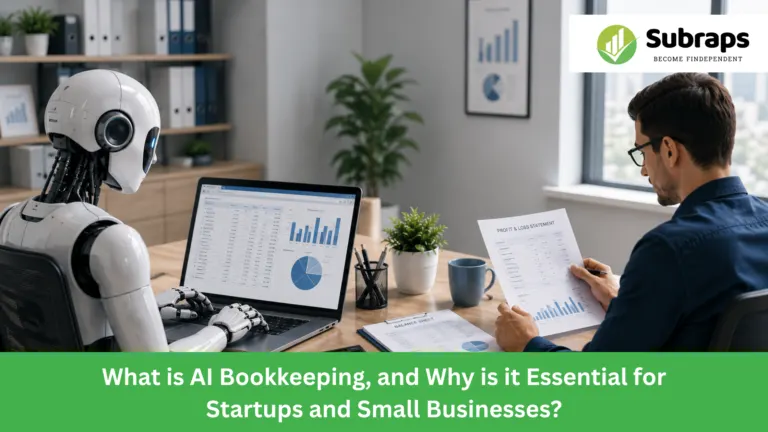
A small business may manually process a few invoices, receipts and expense records.
But as the business expands, so does the volume of transactions, the number of channels through which documents arrive, and the potential for bookkeeping to fall behind, leading to missed entries and month-end backlogs.
Here’s where AI bookkeeping comes in.
Startups and small businesses often work with limited finance teams, but all teams expect accurate records, timely reports, tax compliance, and clear cash flow visibility. AI-powered bookkeeping helps automate repetitive tasks such as reading invoices, extracting transaction details, suggesting ledger categories, and preparing entries for human review.
This means that decision makers, business owners and finance professionals will now benefit from faster, more accurate and scalable financial workflows.
What is AI Bookkeeping?
AI bookkeeping refers to the use of artificial intelligence to automate repetitive bookkeeping tasks and reduce the need for manual data entry.
Put simply, AI can evaluate financial documents, extract the most relevant data, and prepare transactions for review prior to entering them into the accounting system.
Automated bookkeeping can help with tasks such as:
- Reading bills and receipts
- Search for vendor information
- Extract invoice date and number
- Recording amounts, tax values and payment conditions
- Types of expenses
- Recommending the appropriate ledger account
- Transaction preparation for approval
AI may utilize previous transactions to accelerate and enhance the accuracy of document processing. But accountants still need to review exceptions, apply tax laws and approve entries.
How does AI Bookkeeping Automate the Accounting Workflow?
AI bookkeeping begins when a business uploads a financial document, such as an invoice, receipt, expense bill, or debit note.
As part of the accounting automation process, the system reads the document, extracts key details, and converts them into structured accounting data.
A typical workflow includes:
Document Imaging
The document can be submitted via email, WhatsApp, scan or bulk upload.
Data Extraction
AI reads info like vendor name, invoice number, date, amount, tax and line items.
Account Suggestions
The system suggests the appropriate ledger account, tax treatment, or expense category based on previous entries.
Human Review
An accountant checks the extracted data and confirms that the transaction is classified correctly.
Approval & Posting
Once it’s approved, it’s uploaded into accounting software like Tally or Zoho Books.
Other platforms also keep an audit trail and learn from past corrections. This enhances future recommendations while keeping the finance team in control.
Why is AI Bookkeeping Essential for Startups and Small Businesses?
AI-powered bookkeeping is especially helpful for businesses that have limited finance resources and one person doing multiple accounting tasks.
It can help in the following areas:
Track Your Expenses
With AI, recording and classifying expenses becomes more consistent, providing business owners with better visibility around spending.
Supplier Payment
Faster document processing helps teams keep track of upcoming payments and avoid missed obligations.
Customer Collections
Having up-to-date financial records makes it easier to monitor outstanding invoices and follow up with customers.
Cash Flow
Disclosure startups can monitor runway and manage spend, small businesses can manage working capital more effectively.
Financial Statement
Quick bookkeeping means faster month-end closing and more accurate management reports.
Bookkeeping automation removes the repetitive tasks and provides timely financial data for the month. But there will still be a need for accountants to check entries, manage exceptions and verify accuracy.
What Processes can You Automate with AI Bookkeeping Today?
AI bookkeeping won’t replace every accounting decision, but it can automate many repetitive processes while keeping the finance team in control.
Data Extraction
From invoices and receipts, AI is able to read invoices and receipts, capturing information like vendor name, document number, transaction date, taxable amount, tax value and total amount.
Classification of Expense
The system can look at the details of the document and past transactions and suggest an appropriate expense category.
Mapping Ledger
AI is able to recommend the right ledger account based on past mappings approved by the user. The reviewer can accept or reject the suggestion.
TDS & GST Review
ZapBooks AI is able to review the GST and TDS information before the transaction approval. An accounting professional should still determine the final tax treatment.
Duplicate & Exception Detection
The system can flag incomplete, duplicate or inconsistent entries to allow the finance team to focus on transactions requiring attention.
Preparation and Posting of Vouchers
Once reviewed and approved, the transaction can be converted to the required voucher and posted in Tally or Zoho Books.
Creation of Audit-Trail
The workflow keeps track of the submitter, reviewer, corrector, approver and poster of each entry to facilitate tracing of transactions.
How do AI and Human Bookkeepers Work Together?
AI is best used in bookkeeping to carry out repetitive tasks, while accountants continue to be responsible for review and decision-making.
AI handles the repetitive tasks
AI is able to read your financial documents, pull out details of transactions, spot patterns in vendors, suggest which ledger account to use, and flag entries that don’t make sense.
The data is read by bookkeepers.
Bookkeepers are real people who review transaction details, fill in missing information, deal with exceptions, and verify how the ledger is organized.
Accountants Apply Professional Judgment
For some deals, you need to decide based on accounting rules, tax laws, importance of the transaction and the type of expense.
If you are looking at a bill for equipment repair, AI might spot the vendor, the amount and the tax. However, whether the cost is expensed as a repair or capitalized as an asset is a decision for the accountant.
This human review remains in the workflow with ZapBooks AI. In Tally or Zoho Books an entry is not shared until it is reviewed and approved.
AI speeds up bookkeeping, but the professionals keep the control, accuracy and financial sense.
How can Subraps Strengthen Your Business’s Financial Workflow?
Subraps helps companies improve their financial operations by merging accounting knowledge with practical finance automation.
With this support, companies can:
- Get receipts and invoices from different sources.
- Get transaction details automatically
- Verify the accuracy of the accounting data
- Go through the details of GST and TDS.
- Approve posts before they go live.
Post approved records in Tally or Zoho Books
Maintain an open audit trail.
The idea is not to just add another tool to deal with money. And the aim is to make the process easier, from submitting documents to obtaining accurate accounting records.
Subraps also provide a review of management information, reporting deadlines, internal controls and reconciliations. This can enable businesses to clear backlogs, provide clarity and give accountants more time to perform analysis and advisory work.
Conclusion
Automated bookkeeping could help startups and small businesses reduce the time spent on monotonous financial tasks while leaving the rest to human review and oversight.
By automating tasks like data extraction, ledger suggestions, tax checks, and transaction preparation, businesses can maintain more accurate and up-to-date records.
It’s worth more than faster data entry. It makes the financial flow more reliable and therefore easier to see expenses, report on them and make decisions.
Visit Subraps to explore financial automation and outsourcing solutions that reduce manual work, improve operational efficiency, and help your team focus on growing the business.
