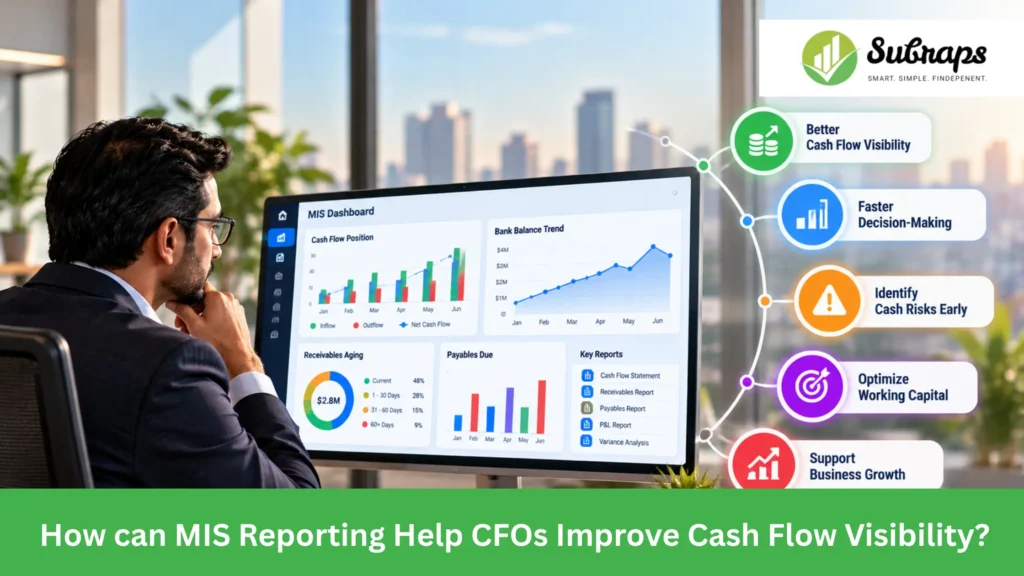
Your P&L shows a healthy profit, but your cash position tells a different story. What is going wrong?
As a CFO, you may have P&L, balance sheet, cash flow, AR, and AP reports but still struggle to see what is putting pressure on cash. Delayed customer collections, rising payables, or tied-up working capital may be hidden across different reports and spreadsheets.
MIS reporting brings these numbers together so you can see where cash is tied up, understand what changed, and act sooner.
In this blog, we’ll look at how MIS reporting can improve cash flow visibility, what financial areas you should monitor, and how better management reporting can support your decisions.
What is MIS Reporting, and What does it Tell You?
MIS reporting is the process of turning financial and operational data into management information that helps you understand business performance and make informed decisions.
As a CFO or finance leader, you need more than a monthly P&L. You need to know whether customer collections are slowing, margins are changing, expenses are above budget, or working capital is becoming tighter.
A useful MIS reporting pack can bring together:
- P&L and balance sheet
- Cash flow
- Accounts receivable and payable
- Budget versus actuals
- Variance analysis
- Financial ratios
- Management dashboards
The value comes from connecting these figures so you can understand not only what changed, but also where you may need to act.
Why can a Profitable Business Still Have Tight Cash Flow?
A profitable business can still have tight cash flow when revenue has been recorded but the related customer payments have not yet been collected.
For example, your business may record ₹50 lakh in sales while ₹15 lakh remains outstanding with customers. Your P&L may look healthy, but you still need cash for supplier payments, salaries, taxes, and other operating expenses.
Your cash position can also be affected by inventory, accounts payable, operating costs, and other working capital movements.
That is why looking only at profit or the bank balance may not give you the complete picture.
What should Your MIS Reporting Include?
Your MIS reporting should include the financial information you need to monitor cash, profitability, working capital, and changes in business performance.
| MIS Area | What You Need to Understand |
| P&L | Revenue, costs, and margins |
| Balance Sheet | Assets, liabilities, and equity |
| Cash Flow | Cash coming in and going out |
| AR Ageing | Outstanding customer balances |
| AP Ageing | Supplier obligations and payment commitments |
| Budget vs Actual | Actual results against your plan |
| Variance Analysis | What changed and why |
| Financial Ratios | Liquidity and performance trends |
You do not need every possible metric in every report. If cash flow is your priority, AR ageing, AP ageing, working capital, collection trends, and cash movement may need more attention.
How can MIS Reporting Improve Your Cash Flow Visibility?
MIS reporting can improve your cash flow visibility by connecting receivables, payables, profitability, working capital, and cash movement in one management view.
See where Customer Collections are Slowing
Your AR ageing report can show where customer collections are slowing and how long outstanding balances have remained unpaid.
If sales are increasing while older receivables are also growing, you have an early warning that revenue is not converting into cash quickly enough.
This gives you a clearer view of where collection attention may be needed.
Understand Upcoming Payment Pressure
Your AP information can show which supplier payments are due and how they may affect your upcoming cash requirements.
When you review AP alongside expected customer collections, you can better understand the timing between money coming into the business and money going out.
Understand Why Cash Changed
Variance analysis can help you understand why your cash position changed instead of simply showing that it changed.
For example, a change in operating cash flow may be linked to slower collections, higher expenses, increased inventory, or changes in supplier payments.
This gives you more context when reviewing financial performance.
Compare Actual Results With Your Plan
Budget-versus-actual reporting helps you identify where your financial performance is moving away from your plan.
If expenses are consistently above budget or collections are below expectations, you can investigate the reason and decide whether action is needed.
Review Profitability Alongside Cash
Reviewing profitability alongside cash flow helps you identify situations where revenue and profit are growing but cash conversion is weakening.
Looking at revenue, margins, receivables, payables, and cash together gives you a more complete view of business performance.
If you also want to understand how technology can improve the finance processes behind your financial data, read our guide on how software development can improve finance and accounting workflows.
How can You Make MIS Reporting More Useful for Management?
You can make MIS reporting more useful by building your reports around the financial questions you need to answer, rather than simply collecting more numbers.
For example, your management team may need to know:
- Are customers paying within agreed terms?
- Which costs are increasing?
- Are margins improving or falling?
- Where is working capital tied up?
- Which areas are outside budget?
- What could affect cash in the next period?
Your reports should also explain important movements. A 12% increase in expenses is only the starting point. You need to understand whether it came from higher business volume, a one-time expense, supplier price changes, or another reason.
A predictable reporting schedule is equally important when management depends on the information for regular reviews.
When should You Improve Your MIS Reporting Process?
You should improve your MIS reporting process when preparing reports takes more time than analyzing the information they contain.
You may notice this when:
- Management reports arrive too late for decisions.
- Your team combines several spreadsheets for every reporting cycle.
- Cash flow changes are difficult to explain.
- AR and AP are reviewed separately from cash flow.
- Budget variances lack useful context.
- Different teams work with different versions of financial data.
- Management repeatedly asks for the same information in different formats.
If your finance team is constantly collecting, checking, and formatting information before every review, the issue may be the reporting process rather than a lack of financial data.
How can Subraps Support Financial Reporting and MIS?
Subraps supports your Financial Reporting and MIS through its FinOps services, helping you turn accounting data into management reports, reporting packs, variance notes, dashboards, and board-ready financial information.
The work goes beyond preparing reports. Subraps can support the finance activities behind those reports, including month-end close, reconciliations, accounts receivable, accounts payable, and audit support. This helps ensure your management information is based on organized and review-ready financial data.
Subraps brings finance and automation expertise to this work, with:
- 1,000+ hours saved across client engagements
- 20 years of combined finance and automation expertise
- 80% average efficiency gain across reengineered workflows
With experience across accounting, reporting, finance operations, and automation, Subraps works as a trusted finance and accounting automation services partner for businesses that need more than routine reporting.
The goal is to give you timely financial information, clearer performance visibility, and the context you need to make better business decisions.
Conclusion
MIS reporting helps you understand what is happening behind your financial numbers, especially when profit and cash flow are telling different stories.
Your business can show healthy revenue and profit while cash remains tight because customer collections are slow, supplier commitments are increasing, or working capital is tied up.
By reviewing P&L, balance sheet, cash flow, AR, AP, and variance information together, you can get a clearer view of what is changing and where action may be needed.
The goal is not to create a bigger reporting pack. It is to give you the right financial information at the right time, with enough context to support better decisions.
If your current MIS reporting process takes too much time or does not give you enough cash flow visibility, book a free consultation call with a finance expert and discuss your reporting requirements with the Subraps team.
FAQs
1. How often should you review MIS reports for cash flow management?
You should review key MIS reports regularly, such as weekly or monthly, based on your business needs. More frequent reviews can help you spot cash flow pressure earlier.
2. Can MIS reporting work with my existing accounting software?
Yes. MIS reporting can use data from your existing accounting system and other finance sources, allowing you to build management reports without replacing the systems you already use.
3. Can MIS reporting help identify future cash flow problems?
Yes. By tracking receivables, payables, cash movements, budgets, and variances, MIS reporting can help you identify warning signs early and plan for upcoming cash requirements.
