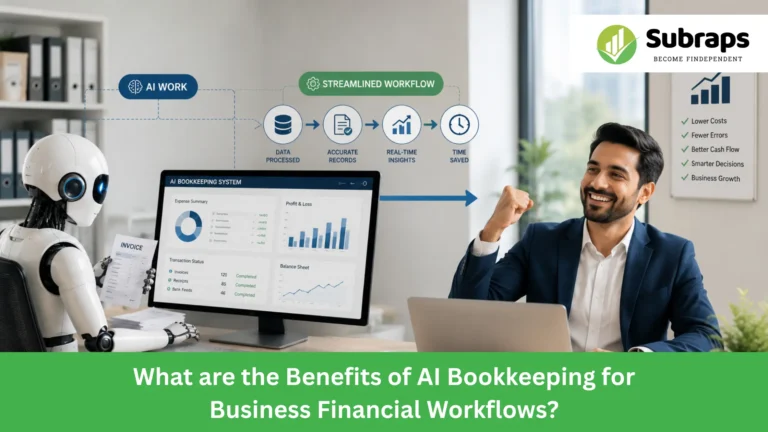
Artificial intelligence in bookkeeping refers to software that can capture, categorize, and process financial transactions with less manual input. Instead of entering every invoice, receipt, or bank transaction by hand, AI-powered bookkeeping tools can extract key details, suggest the correct ledger account, identify possible duplicates, and highlight entries that need attention.
For businesses managing financial records, vendor payments, payroll, expenses, and bank reconciliations at the same time, this can reduce delays and minimize errors that may otherwise appear during month-end or year-end reviews.
AI bookkeeping does not replace accountants. It handles repetitive processing so finance professionals can focus on validation, compliance, financial controls, reporting, and better business decisions.
Why are Businesses Adopting AI Bookkeeping?
Businesses are adopting AI bookkeeping to reduce manual data entry, minimize errors, and speed up financial closing. As transaction volumes grow, finance teams often struggle to manage invoices, expenses, reconciliations, tax records, and reporting on time.
AI helps by reading documents, extracting key details, matching transactions, suggesting account categories, and preparing entries for review. This creates a smoother workflow while allowing finance professionals to focus on validation, compliance, and financial analysis.
What are the Main Benefits of AI-powered bookkeeping for Business Financial Workflows?
Integrating AI into bookkeeping improves financial workflows by automating repetitive tasks, reducing manual errors, and providing more timely financial insights. This helps businesses scale efficiently, speed up month-end closing, and allow finance teams to shift from data entry to financial analysis and strategic planning.
Automates Repetitive Bookkeeping Tasks
Automating routine tasks such as data entry, expense categorization, invoice processing, and bank reconciliation can significantly reduce the time spent on manual bookkeeping.
AI-powered tools can capture financial data, suggest account categories, match transactions, and keep records updated more consistently. This reduces avoidable errors and allows finance teams to focus on exceptions, reviews, and higher-value financial work.
Improves Financial Accuracy and Reduces Errors
Consistent AI-assisted bookkeeping improves financial accuracy by applying the same rules across invoices, expenses, and transactions. It can identify duplicate entries, missing details, unusual amounts, and incorrect classifications before they affect reports.
With human review and approval, businesses can maintain cleaner records, support tax compliance, improve cash flow visibility, and make decisions using more reliable financial information.
Provides Timely Financial Insights
AI bookkeeping helps keep financial records updated by processing invoices, expenses, and bank transactions more consistently. This gives business owners clearer visibility into revenue, costs, receivables, payables, and cash movements without waiting until month-end.
With more current financial data, management can identify rising expenses, delayed customer payments, and cash flow concerns earlier.
Speeds Up Invoice and Expense Processing
AI can extract key information from invoices and expense documents, including supplier names, invoice numbers, dates, amounts, payment terms, and tax details.
Instead of entering every item manually, finance teams can review prepared transactions and focus on incomplete, unusual, or high-risk entries. This reduces processing delays, prevents documents from being overlooked, and supports better payment planning.
Simplifies Bank Reconciliation
Bank reconciliation is essential for confirming that accounting records match bank statements, but checking every transaction manually can take considerable time.
AI-assisted reconciliation can match bank transactions with recorded entries, apply predefined rules, and suggest categories for unmatched items. Accountants can then concentrate on genuine discrepancies rather than reviewing routine matches line by line.
Improves Cash Flow Visibility
Strong cash flow management requires more than checking the current bank balance. Businesses also need accurate information about customer collections, supplier payments, operating expenses, and upcoming tax obligations.
By processing invoices, receipts, and payments more consistently, AI-powered bookkeeping helps maintain updated receivable and payable records. This allows management to identify overdue accounts, plan upcoming payments, and make better working capital decisions.
Strengthens Compliance and Audit Readiness
Missing documents, incorrect classifications, and unclear approval records can create compliance problems and delay audits.
AI-supported workflows can organize source documents, transaction details, corrections, reviewer actions, and approval histories in one traceable process. This creates a clearer audit trail and makes financial records easier to verify.
Complex tax treatments and unusual transactions should still be reviewed by qualified accounting professionals.
Reduces Manual Work and Operating Costs
The value of AI bookkeeping is not about replacing finance employees. It comes from reducing the time spent on data entry, document handling, transaction matching, and correcting avoidable errors.
As transaction volumes increase, businesses can process more financial information without increasing administrative effort at the same rate. This helps control operating costs while maintaining a consistent bookkeeping workflow.
Increases Finance Team Productivity
Finance professionals provide greater value when they analyze performance, strengthen controls, support forecasts, and advise management.
AI bookkeeping reduces repetitive data preparation and gives teams more time to review financial results. Instead of checking whether an invoice was entered, they can focus on why costs are rising, which customers are paying late, and where profit margins are changing.
Supports Better Business Decisions
Business leaders regularly make decisions about hiring, pricing, equipment purchases, supplier terms, cost control, and expansion. These decisions become more difficult when financial reports are delayed or incomplete.
By improving the speed, accuracy, and consistency of bookkeeping, AI provides management with more reliable financial information. This helps leaders evaluate risks, understand financial consequences, and make better-informed business decisions.
How can Subraps Improve Your Financial Workflow with AI Bookkeeping?
Subraps provides businesses with end-to-end financial support, from Finance Automation to outsourced accounting services.
By automating repetitive processes and outsourcing time-consuming financial tasks, businesses can improve accuracy, streamline reporting, strengthen financial control, and reduce the pressure on internal teams.
This allows finance professionals to focus more on operational efficiency, business performance, and long-term growth.
Conclusion
AI bookkeeping helps businesses build a faster, more accurate, and better-organized financial workflow. By automating document capture, transaction processing, reconciliation, and other repetitive tasks, companies can reduce delays, strengthen compliance, and give finance teams more time for analysis and advisory work.
The real value goes beyond saving time. It provides more reliable financial information, clearer cash flow visibility, and stronger support for day-to-day business decisions.
Visit Subraps to explore finance automation and outsourcing solutions that simplify financial operations, improve efficiency, and help your business scale with greater control.
