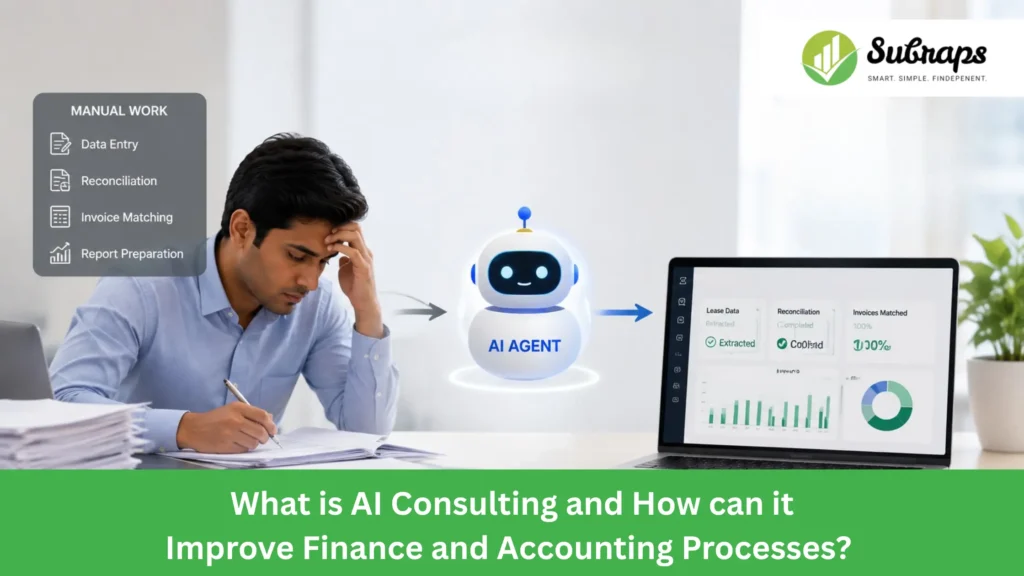
Many finance teams know AI can help, but the real challenge is knowing where to start.
Should you automate invoice processing, reconciliations, reporting, document checks, or another finance workflow? Which process will create the most value, and how will it fit with your existing systems and controls?
Without a clear plan, businesses can easily invest in the wrong tools or automate processes that first need to be improved.
This is where AI consulting helps. It gives finance and accounting teams a structured way to identify the right opportunities, improve existing workflows, and implement automation where it can deliver practical business value.
What is AI Consulting?
AI consulting is a specialized service that helps businesses identify where AI can improve existing processes, reduce repetitive work, and create measurable business value.
For finance and accounting teams, this starts with reviewing current workflows, finding time-consuming manual tasks, and identifying the processes that are suitable for automation.
AI consultants can then help redesign those workflows, build suitable AI agents or automation solutions, and connect them with existing finance and accounting systems.
The goal is not to add AI everywhere. It is to use it where it can reduce manual effort, save time, improve process efficiency, and give finance teams more time for review, analysis, and better financial decisions.
What does an AI Consultant do for Finance and Accounting Teams?
An AI consultant helps finance teams move from knowing they have too much manual work to understanding exactly where improvements can be made.
Instead of automating everything at once, the consultant helps the business focus on the processes where time, effort, or errors can be reduced.
An AI consultant can help finance teams:
- Find where finance teams lose the most time
- Identify repetitive and manual tasks
- Prioritize the best processes to automate
- Plan how the improved workflow should work
- Keep human review where it is needed
- Connect automation with existing finance systems
- Reduce repeated data entry, checking, and follow-ups
- Measure time saved, errors reduced, and process improvements
This gives finance leaders a clearer way to decide where automation is worth the investment and where existing processes should remain under direct human control.
How does the AI Consulting Process Work from Discovery to Scale?
A practical AI consulting process should start with the workflow, not the technology. At Subraps, the approach moves from understanding the current process to redesigning it, deploying the right solution, and then scaling what works.
1. Discover the Right Workflows
The first step is to understand how finance and accounting work moves from one stage to the next.
This includes looking at where tasks slow down, where information changes hands, and where teams depend on repeated manual steps. The aim is to identify workflows that are worth improving first.
2. Reengineer the Process
Before automating anything, the workflow is reviewed and simplified.
Unnecessary steps are removed, responsibilities are made clearer, and the process is redesigned around the outcome the business actually needs. This helps avoid automating a process that is already inefficient.
3. Deploy the Right AI Agent
Once the improved workflow is clear, the right AI agent can be introduced into the process.
It can take care of selected routine steps while finance teams continue to handle approvals, exceptions, and decisions that need financial judgment.
4. Scale What Works
Once the first workflow is working well, the same approach can be extended to other finance, accounting, or operational processes.
This helps businesses scale automation step by step based on proven results, rather than trying to automate several processes at once.
Key Takeaways for Finance Teams from AI Consulting
AI consulting helps finance teams make better automation decisions before investing time and money in solutions that may not fit their actual needs.
- Vendor Noise Problem: Many tools claim to automate finance, but not every solution fits your accounting workflows, systems, or control requirements.
- Implementation Gap: Choosing a tool is only the beginning. Real value comes when it works properly with your existing systems, approvals, and finance processes.
- Strategy Before Technology: Start with the finance problem, expected outcome, and process gap before deciding which technology to use.
- Automation Needs Control: Finance processes still need clear approvals, review points, exception handling, and accountability.
- Measure Business Value: Track whether the change is reducing processing time, manual effort, rework, or operating costs.
Looking to Improve Your Finance and Accounting Processes?
If your current finance process is working but still depends on too many manual touchpoints, AI consulting can help identify where the right changes can create the most value.
Subraps helps businesses move from these process gaps to practical finance and accounting automation, with solutions designed around existing workflows, controls, and business needs.
Conclusion
AI consulting gives finance teams a clearer way to choose the right processes for automation and make sure the solution fits how the business actually works.
Ready to see where automation can make the biggest difference in your finance team?
Book a Free Consultation to discuss your finance and accounting automation needs.
