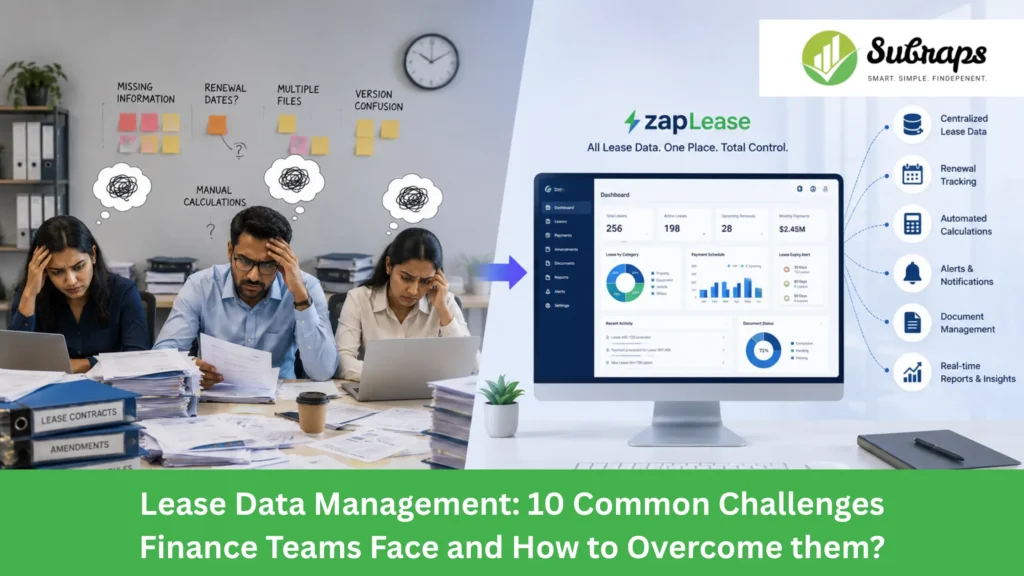
Managing lease information is relatively simple when a business has only a few contracts. A spreadsheet, a folder of agreements, and calendar reminders may be enough.
But that approach becomes difficult as the lease portfolio grows.
A finance team managing hundreds of property, equipment, vehicle, or other leases may need to keep track of contract terms, payment details, renewal dates, amendments, accounting inputs, supporting documents, and information across multiple entities.
When that data sits across spreadsheets, PDFs, emails, and shared folders, finance teams spend more time finding and checking information before they can use it.
This is where lease data management becomes important.
What is Lease Data Management?
Lease data management is the process of collecting, organizing, updating, tracking, and accessing information across a company’s lease portfolio.
It typically includes:
- Lease commencement and end dates
- Payment terms
- Renewal and termination conditions
- Notice periods
- Rent escalations
- Lease amendments
- Entity and location details
- Accounting inputs
- Supporting documents
The goal is not simply to store lease contracts. Finance teams need reliable lease information that is easy to find, current, and ready to use for accounting, reporting, planning, and audit requirements.
10 Common Lease Data Management Challenges
Lease data problems usually become more visible as the number of leases increases.
For example, a team managing 500 leases is not working with only 500 contracts. Each lease may also have spreadsheets, schedules, amendments, supporting documents, payment information, and important dates that need to remain accurate throughout the lease term.
Here are ten common challenges finance teams face.
1. Lease Information is Scattered Across Multiple Places
The contract may be stored as a PDF, payment details in Excel, amendments in another folder, and renewal communication in email.
Finance teams often have to search several locations just to understand one lease.
2. Finding Specific Contract Terms Takes Time
Sometimes the team only needs one piece of information, such as an escalation clause, notice period, renewal option, or payment term.
When lease terms are not captured in a structured format, someone may need to reopen and review the agreement each time that detail is required.
Multiply that work across hundreds of leases, and contract searching quickly becomes a recurring task.
3. Different Versions of the Same Lease Data Exist
Multiple people may maintain their own spreadsheets or copies of lease information.
If one person updates a lease amendment but another file still contains the old terms, the finance team has to determine which record is correct before using it.
Without a clear source of current information, every update can create another version to manage.
4. Renewal and Expiry Dates can be Missed
Lease portfolios contain many dates that require attention, including:
- Expiry dates
- Renewal dates
- Notice deadlines
- Rent review dates
- Modification dates
When these dates depend on spreadsheets or individual reminders, important events can be overlooked.
Good lease renewal tracking gives teams visibility before a deadline becomes urgent.
5. Lease Amendments are Difficult to Follow
Lease agreements often change during their term.
An extension, payment revision, termination, or other modification may create a new document and new information that needs to be connected with the original lease.
When amendments are stored separately, finance teams may need to compare several records before understanding the current terms.
6. Growing Lease Volumes Increase Manual Work
The process that works for 20 leases may not work for 500 or 1,000.
As the portfolio grows, teams spend more time on data entry, updates, checking, reconciliation, and document management.
Adding another spreadsheet may temporarily organize the work, but it does not remove the underlying manual effort.
7. Multi-Entity Lease Data is Hard to Consolidate
Businesses may manage leases across several legal entities, branches, departments, locations, or countries.
If each entity maintains separate records, the finance team may need to combine multiple files before getting a complete view of the portfolio.
This makes consolidated lease reporting slower and more dependent on manual checks.
8. Duplicate and Inconsistent Records Create Extra Checking
The same lease may appear in different trackers or folders.
One record may contain the original payment amount while another reflects the latest amendment.
These inconsistencies make teams spend additional time validating information before they can rely on it.
9. Finance Leaders Have Limited Portfolio Visibility
Finance leaders often need answers that go beyond one lease.
They may want to know:
- Which leases expire in the next six months?
- Which leases were recently modified?
- How many leases belong to each entity?
- Which records need review?
- Where are the largest lease commitments?
When lease information is spread across disconnected files, getting these answers can require additional consolidation work.
10. Too Much Finance Time Goes Into Administration
This is often the biggest impact of poor lease data management.
Finance professionals spend time searching for documents, checking versions, updating spreadsheets, validating information, and responding to requests for lease data.
That reduces the time available for reviewing exceptions, analyzing financial impact, supporting management, and preparing for reporting or audit work.
How can Finance Teams Improve Lease Data Management?
Better lease data management starts with keeping lease information in one reliable place. Key terms, amendments, renewal dates, expiry dates, and entity details should be structured and updated consistently.
This gives finance teams quick access to current lease information without repeatedly searching contracts, folders, and spreadsheets.
How does ZapLease Work for Lease Data Management?
ZapLease gives finance teams one place to organize and manage lease information across their portfolio.
Instead of working across separate spreadsheets, contracts, schedules, and folders, teams can keep lease details, important dates, amendments, entity information, and accounting-related data in a structured platform.
With ZapLease, finance teams can:
- Access lease information quickly
- Track renewals, expiries, and important dates
- Keep amendments linked to the relevant lease
- Manage leases across multiple entities
- Get a clearer view of the overall lease portfolio
- Access information needed for accounting and audit review
For growing lease portfolios, this helps reduce the time spent searching, updating, and checking lease data.
Want to Simplify Your Lease Data Management?
At Subraps, we provide ZapLease, a specialized lease accounting platform that helps finance teams manage lease data more easily from one place.
Centralize your lease information, reduce repetitive manual work, and make your growing lease portfolio easier to manage.
Book a Free Consultation to see how ZapLease can simplify your lease data management.
